Showing posts with label Health and Beauty. Show all posts

July 22, 2011

How Do I Know if a Food is Organic?

Before you buy organic products, you need to know whether they are genuinely organic. 

One of the best ways to find out is to look for the organic certification logos and the word "organic" on product labels. 

Here are some guidelines on how to differentiate the labels according to U.S. Department of Agriculture (USDA) standards.

100% Organic:
The product has been made using pure organic ingredients. The manufacturer has also processed, packed, handled and transported the product in full compliance with the USDA standards for organic agriculture.

Organic:
This product contains at least 95 % organic ingredients (excluding water or salt). It is eligible for the organic label provided the remaining 5% of the ingredients are not commercially available in organic form, and not produced using specifically prohibited methods (i.e. irradiation).

Made with Organic Ingredients:
The product labeled "Made with organic ingredients" must contain between 70% - 95% organic ingredients, excluding water and salt. As many as three of the organic ingredients in the content may be listed on the front of the package

Product with less than 70% organic ingredients:
The label on this product will be allowed to list the organic items in the "ingredients" panel only, and the term "organic" may not be used anywhere else on the package.

One common misconception is that "natural" equals "organic". While "natural" usually indicates foods that have been minimally processed or without added artificial ingredients, it does not address the way that food is grown.

January 29, 2011

Organic Facts

Here's more organic facts and what other terms mean legally:

Organic fruits and vegetables were grown without synthetic pesticides, synthetic fertilizers or sewage slude and haven't been genetically engineered and irradiated.

Organic beef and chicken come from animals that weren't the offspring of cloned animals. They were raised on 100% organic feed, were never given growth hormones, antibiotics or other drugs and their meat was never irradiated.

Organic milk comes from animals that, for at least the past 12 months, were fed 100% organic feed and weren't given antibiotics or growth homones like rBST. This organic fact alone gets me to drink organic milk.

Organic eggs come from hens that were fed 100% organic feed and were never given growth hormones or antibiotics.

Organic seafood doesn't mean a thing, since USDA hasn't defined the term.

Cage-free eggs come from hens that were not confined to cages and that may or may not have had access to the outdoors. They're not necessarily organic.

Free range or free roaming poultry have access to the outdoors, but for no minimum time. They're not necessarily organic. Cage-free poultry doesn't mean anything, since most chickens grown for meat are kept indoors (but cage-free) until they're transported to slaughter.

No hormones administered can appear on beef labels if the producer can document that the animals were raised without hormones.

Hormone-free is an illegal claim, since all animals produce their own hormones.

No antibiotics added can appear on a label if the producer can document that the animals were raised without antibiotics.

Natural (or All Natural) meat or poultry products contain "no artificial ingredients and are no more than minimally processed." They're not necessarily organic, though some supermarkets try to make them appear to be.


May 30, 2010

Halal Certifications


Islam has laws regarding which foods can and cannot be eaten and also on the proper method of slaughtering an animal for consumption, known as dhabihah

Halal Certification is a recognition that the products are permissible under Islamic law.  These products are thus edible, drinkable or usable by Muslims.

Organic Certifications

Before buying organic products, you have to make sure that they are genuinely organic.

One of the best ways to find out if the organic products are genuinely organic is to look for organic certification logos on the product packaging.

Here are some of the important certification bodies around the world that ensure the production, storage and processing of organic food are done within strict guidelines.


Argentina


Australia


Brazil


Bolivia


China


EU


Germany


Germany


Germany


Germany


Germany


Holland


Italy


Italy


Italy


Japan


Malaysia


Malaysia


New Zealand


New Zealand


Switzerland


Sweden


Thailand


UK


USA


USA


USA


USA


USA


USA

How Is Your Heart's Health?

Spare some time to discover your cardiovascular system's status.

Answer 'Yes' or 'No' to the following checklist:
  •     You go for health check less than once in 1 ½ years
  •     You or a close relative is diabetic
  •     Your weight exceeds the standard (overweight/obese)
  •     You or a close relative has high blood pressure
  •     You smoke
  •     You have gout or high uric acid level
  •     Your family member smokes at home
  •     You take excessive alcohol
  •     You exercise less than 3 times weekly
  •     You are stressed/depressed
  •     You take junk/processed food frequently
  •     You like soup, cheese, gravy and fried food
  •     You eat preserved, high salt or sweet food
  •     You eat food rich in saturated fat like animal fat, butter and egg
  •     Your diet is made of low fibre food like nuts, vegetables, fruits and cereals
  •     Your family member suffers heart attack or stroke
  •     If you are male, are you experiencing thinning hair?
  •     If you are female, are you experiencing menopause?
  •     Do you take birth control pills?
  •     You are over 45 (male) or 55 (female)

If you answer more 'Yes' than 'No', you have a greater risk of cardiovascular diseases.

Know your heart and the risk factors and take preventive measures to maintain a healthy cardiovascular system.


Warm regards,
Sany Woo

May 23, 2010

Are You Suffering From An Acidic Body?

Some of the signs of an acidic body can be very subtle if you're not trained to pay close attention to your body.

Your body works best when you blood pH level is slightly alkaline (ie. between pH7.35 and 7.45). However, due to poor eating habits, stress, lack of exercise and pollution, most people have slightly acidic blood levels. This can also be caused by a diet high in meat or refined carbohydrates and low in fibre.
Acidic body is the main cause of poor energy levels and all chronic degenerative diseases including heart diseases, arthritis, osteoporosis, kidney and gall stones and cancer are associated with excess acidity in the body.

Acidic blood has a higher viscosity, thus preventing smooth blood flow, leading to poor oxygen and nutrient transfer into your cells. Body acidity also stresses your organs, causing them to deteriorate. Once weakened, your body becomes more susceptible to diseases.

The checklist below helps you to identify your risk.

Do you...
  • Perform tasks at a very slow pace
  • Feel sleepy when driving or riding in a car
  • Feel sleepy in a confined area or small room
  • Tire easily after mild exercise
  • Suffer from poor memory or concentration
  • Cold hands and feet
  • Bruise easily or have sensitive, bleeding gums
  • Prone to eczema or other skin problems
  • Have dull complexion or acne
  • Suffer from athlete's foot or sensitive hands
  • Slow healing wounds
  • Put on weight easily or unable to lose weight
  • Frequent constipation
  • Frequent diarrhoea
  • Have bad breath or body odour
  • Frequently suffer from ringing in the ears (tinnitus)
  • Often feel dizzy
  • Tiredness especially in the afternoons
  • Weak immune system; prone to coughs, flu and fever
  • Frequently bitten by mosquitoes or insects
  • Persistent stiff neck or frozen shoulders
  • Unexplained aches and pains not attributed to arthritis
  • Frequent late nights
  • Frequently eat supper or have dinner after 8pm
  • Frequently skip breakfast
  • Smoke or surrounded by those who smoke
  • Drink alcoholic beverages
  • Drink 3 or more cups of coffee daily
  • Drink carbonated beverages daily
  • Frequently consume meat, eggs or dairy products
  • Eat very few fruits and vegetables
  • Drink less than 2000ml of water each day
  • Drink distilled or RO water
  • Often consume processed, frozen or canned food
  • Frequently eat fried foods
  • Love sweet or starchy snacks
  • Lack physical exercise
  • Live or work under constant pressure
  • Regularly exposed to pollution or toxins
  • Consume polished rice (white rice) or bread
If you check 5 or more, your risk of acidity is high. 


May 21, 2010

Check If You're Suffering From Heavy Metal Toxicity

The World Health Organization (WHO) reported that "82% of all chronic degenerative diseases are caused by environmental exposure to toxic metals".

Heavy metals such as lead, mercury and cadmium are extremely toxic to our cells, especially our brain cells and nerves as they tend to bio-accumulate in the body. This means that unless you take some drastic actions, the concentration of heavy metals in your body (or your child's) will increase as time goes by, until they reach a point where the metabolic functioning of crucial enzymes is disturbed or inhibited.

Use the checklist below to check if you're suffering from heavy metal toxicity.

Do you...
  • Frequently feel tired or often lack energy to do things you like
  • Sleep poorly or often wake up feeling more tired than when you went to bed
  • Get depressed easily or suffer frequent mood swings
  • Suffer frequent headaches or migraines
  • Experience dizziness and ringing in the ears (tinnitus)
  • Suffer from bleeding or sore gums
  • Experience forgetfulness, brain fog or difficulty concentrating
  • Experience muscle twitches or numbness and tingling sensation in your hands or legs
  • Suffer from sinus, hay fever, respiratory allergies or food allergies/intolerance
  • Suffer from TMJ (Temporal Mandibular Joint) problems
  • Experience numbness or a burning sensation in your mouth or gums
  • Catch colds, flu or other infections easily
  • Have poor balance eg. difficulty standing on one foot with your eyes shut
  • Work as a dentist, dental assistant, printer, plumber, welder, miner, mechanic, petrol station attendant, metal worker, carpenter, electrician, hair dresser, painter or in a chemical, pesticide or herbicide factory or paper mill
  • Have 4 or more amalgam tooth fillings
  • Sometimes have a 'metallic' taste in your mouth
  • Generally don't feel well but was told by your doctor that 'There's nothing wrong with you!'
  • Have dull, sallow skin, pigmentation and age spots on the back of your hands
  • Suffer constipation or diarrhoea
  • Frequently suffer from bad breath or coated tongue
  • Have body odour
  • Experience lower back pain or suffer from a kidney condition
  • Experience frequent mood swings – get anxious or irritated easily
  • Experience chest pains even though your ECG, stress test, X-rays and heart check results turned out normal
  • Pass out stools that are sticky with mucous
  • Suffer from stiff neck, frozen shoulders or body aches and soreness
  • Have a low basal body temperature (below 36.9°C)
  • Have a rapid pulse rate or high blood pressure
  • Often find that prescribed antibiotics 'do not work'
  • Suffer from menstrual problems
  • Suffer from acne, skin rashes or eczema
  • Have brittle hair and nails

May 19, 2010

Nails and Health: Read the Signs


Did you know your nails can reveal clues to your overall health? A touch of white here, a rosy tinge there, or some rippling or bumps may be a sign of disease in the body. Problems in the liver, lungs, and heart can show up in your nails. Keep reading to learn what secrets your nails might reveal. 

Pale Nails


Very pale nails are sometimes linked to aging. But they can also be a sign of serious illness, such as: 
· Anemia 
· Congestive heart failure 
· Diabetes 
· Liver disease 
· Malnutrition 

White Nails


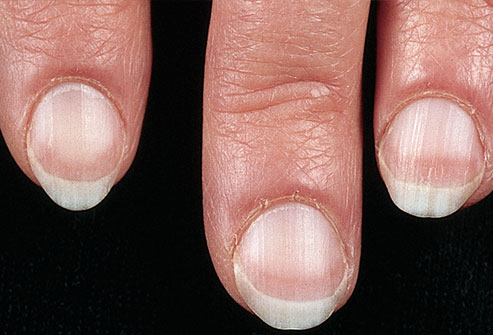
If the nails are mostly white with darker rims, this can indicate liver problems, such as hepatitis. In this image, you can see the fingers are also jaundiced, another sign of liver trouble. 
 
Yellow Nails
 
One of the most common causes of yellow nails is a fungal infection. As the infection worsens, the nail bed may retract, and nails may thicken and crumble. In rare cases, yellow nails can indicate a more serious condition such as severe thyroid disease or psoriasis 
 
Bluish Nails

Nails with a bluish tint can mean the body isn't getting enough oxygen. This could indicate an infection in the lungs, such as pneumonia. 
 
Rippled Nails

If the nail surface is rippled or pitted, this may be an early sign of psoriasis or inflammatory arthritis. Psoriasis is a skin condition that starts in the nails 10% of the time. 
 
Cracked or Split Nails

Dry, brittle nails that frequently crack or split have been linked to thyroid disease. Cracking or splitting combined with a yellowish hue is more likely due to a fungal infection 
 
Puffy Nail Fold
 
If the skin around the nail appears red and puffy, this is known as inflammation of the nail fold. It may be the result of lupus or another connective tissue disorder.
 
Dark Lines Beneath the Nail
 
Dark lines beneath the nail should be investigated as soon as possible. They are sometimes caused by melanoma, the most dangerous type of skin cancer. 
 
Gnawed Nails
 
Biting your nails may be nothing more than an old habit, but in some cases it's a sign of persistent anxiety that could benefit from treatment. Nail biting or picking has also been linked to obsessive-compulsive disorder. If you can't stop, it's worth discussing with your doctor.
 
Nails Are Only Part of the Puzzle
 
Though nail changes accompany many conditions, these changes are rarely the first sign. And many nail abnormalities are harmless -- not everyone with white nails has hepatitis. If you're concerned about the appearance of your nails, see a dermatologist 


Article from: WebMD

May 05, 2010

The lowdown on feeding newborns cow's milk


MANY Malaysian mothers do not breastfeed their newborn babies. The babies are given bottled milk at birth or within a few months after birth. The bottled milk is usually derived from cow's milk which comprises protein, fat, sugar, vitamins and minerals mixed with water. Some babies are allergic to the proteins in cow's milk. This occurs despite the efforts of the milk manufacturers to produce bottled milk that is as close to mother's breast milk as possible.

It is generally accepted that about 1% to 5% of infants are allergic to the proteins in cow's milk and its various formulations.

Nasty reaction: Up to 5% of infants are allergic to the proteins in cow's milk and its various formulations. To avoid the allergy it is advisable to breastfeed the baby for six months or more.

Most infants will, fortunately, outgrow the milk allergies by the time they are two or three years old.

Milk allergy has to be distinguished from lactose intolerance. The former involves the body's immune system but the latter does not. Milk allergic reactions occur with the smallest amount of milk consumed.

Lactose intolerance is usually dose related - small amounts are tolerated by the body but larger amounts lead to a reaction which may mimic milk allergy.

Lactose intolerance is of slower onset than milk allergy and is not life-threatening. It is a harmless condition.

Milk intolerance is due to lactose intolerance which is the inability of the gastrointestinal system to absorb lactose, the primary sugar in milk and milk products such as milk powder, butter, margarine, cheese, yoghurt and chocolate. The lactose composition of milk products can be found by reading the labels of the products.

Lactose comprises two sugars bound together. Its absorption can occur when it is split up into two smaller sugars by an enzyme called lactase which is produced by the cells lining the small intestine. If the amount of lactase is low or absent, the body cannot or would have difficulty in splitting the lactose into two smaller sugars. The lactose then passes into the large intestine where the bacteria there cause it to ferment, producing a large amount of gas.

The amount of lactase in the intestine is high in babies. As the baby grows, the amount of milk consumed decreases leading to a reduction in the amount of lactase in the intestine.

Many Asians are at risk of developing lactose intolerance unlike adults in Europe and North America. Many people develop lactose intolerance when they have diarrhoeal diseases, during which the lining of the small intestine is slightly damaged by the frequent bowel movements. This results in a reduced production of lactose by the cells lining the small intestine.

Other causes of lactose intolerance are diseases of the stomach or intestines and its surgical treatment.

There are, however, some people who have low lactase levels but who are not lactose intolerant. The reason for this is unknown. The symptoms of lactose intolerance are abdominal distension and/or colic, stomach rumbling, increased passage of wind, nausea and diarrhoea.

There is marked variation in the symptoms of lactose intolerance. Some people do not have problems but others have symptoms with a small amount of lactose. Some do not have problems with certain foods which contain lactose but cannot tolerate other lactose-containing foods.

Self diagnosis of lactose intolerance is not difficult. This is done by refraining from consumption of lactose containing foods for a few days and then drinking two to three glasses of milk. If there is a tummy ache or diarrhoea within 30 minutes or so, it is likely that there is lactose intolerance.

The diagnosis of lactose intolerance can be confirmed by tests done by the doctor. One test involves measuring the blood sugar before and after drinking a lactose containing fluid. If the blood sugar is increased, there is no lactose intolerance. Another test involves analysing the breath for hydrogen gas after drinking a lactose-containing fluid. Hydrogen gas will be present if there is lactose intolerance as the lactose-containing fluid will be fermented by the bacteria in the large intestine. If one has an endoscopic examination, which involves passing a tube-like instrument into the stomach and intestine, the lining of the small intestine may be analysed.

Treatment

The treatment of lactose intolerance depends on the severity of the symptoms. If the symptoms are mild, all that is necessary is to reduce the consumption of milk and milk products. If the symptoms are severe, a lactose-free diet would be necessary. The doctor will, in such situations, refer the patient to a dietician who will advise on the composition of a lactose-free diet.

Lactose intolerance can be prevented by abstaining or reducing the consumption of milk and milk products when one has diarrhoea or has just recovered from it.

There are two ways in which cow's milk allergy present: gradually or suddenly. It usually presents gradually before the baby is six months old. The clinical features commonly occur with the passage of loose stools, blood in the stools, vomiting, colic, irritability and poor growth.

It can also present suddenly and rapidly with vomiting, wheezing, swelling of the skin and eyes, and rarely, anaphylactic shock, which is a sudden and severe allergic reaction involving the whole body and which is life threatening. This usually occurs soon after contact with the cow's milk allergen. Both the cardiovascular and respiratory systems are affected with marked changes in the blood pressure and breathing difficulties. Most babies will outgrow their allergy to cow's milk by the time they are two to four years of age.

Cow's milk allergy may also be associated with other allergies like eczema and asthma. If the cow's milk allergy is not addressed adequately, it may lead to effects on growth with failure to thrive and nutritional deficiencies. The management of cow's milk allergy is premised on avoiding cow's milk. This would include a breastfeeding mother avoiding dairy products in her diet, lest it be transmitted to the baby in the breast milk.

The formula for bottle-fed babies has to be changed to one that is soy or hydrolysate-based. The latter contain cow's milk proteins which are less allergenic because they have been broken down. If the allergy is severe, an amino acid based formula is used. Most manufacturers market “hypoallergenic” formula products.

It is important to remember that there is cross allergy between cow's milk and soy milk in up to 50% of the late onset type of cow's milk allergy and 15% of the rapid onset type. If the allergy is severe, treatment with medicines like anti-histamines and adrenaline will be necessary. Vitamin supplementation may also be necessary.

If there is a family history of allergies (eczema and asthma), it is advisable to totally breastfeed the baby for six months or more. This will delay the onset of symptoms if the baby has cow's milk allergy. There are other benefits of breastfeeding which include improved immunity for the child and bonding.

If one wants to provide cow's milk in a child's diet, this may be done when the child is 12 to 18 months old. However, it is advisable to do this under medical supervision. It is important to check all food labels and avoid any food that contains milk or milk products. Advice from a doctor or dietician would be useful if one is unsure.


Dr Milton Lum is a member of the board of Medical Defence Malaysia. This article is not intended to replace, dictate or define evaluation by a qualified doctor. The views expressed do not represent that of any organisation the writer is associated with.

December 12, 2009

Banana Nutrition

BANANA - This is my all time top superfood as it has some extremely powerful effects on the body and, as well as being high in minerals, will amaze you in more ways than one:

The fibre from unripe bananas reduce bad cholesterol and increase good cholesterol by up to 30%. The fibre in bananas is also helpful for constipation.

A ripe banana will soothe an upset stomach.

Bananas are a great energy source for the body which is instant and sustained.

Bananas can relieve heartburn.

They can also help decrease the risk of stroke by as much as 40%.

People suffering from depression feel better after eating a banana as the tryptophan in the banana is converted by the body into serotonin, which helps you relax, improves mood and makes you feel happier. Also helpful for people suffering from Seasonal Affective Disorder (SAD).

Bananas help to regulate blood glucose levels as they also contain the vitamin B6 and can also help with PMS.

Bananas contain iron and can help with anemia.

They are also great for high blood pressure as they are high in potassium and low in salt. The potassium can also help you feel more alert so good for children's packed lunches.

Bananas are great for hangovers - make a milkshake and add honey - the banana calms the stomach and the milk soothes and re-hydrates your body.

If suffering from morning sickness, a banana can help as it keeps blood sugar levels up.

The inside of a banana skin can reduce swelling and irritation from insect bites.

The B vitamins in bananas can help calm nerves.

Bananas are a great mid-morning snack, if watching your weight, as they keep sugar levels steady (great for diabetics), so you are less likely to crave a high carb snack.

If you suffer from Ulcers, bananas are great as they are gentle on the stomach, they neutralize over-acidity and reduce irritation by coating the lining of the stomach.

Bananas can lower both the physical and emotional temperature of expectant mothers.

If you are trying to give up smoking, bananas can help as the B6, B12, potassium and magnesium found in bananas help the body to recover from nicotine withdrawal.

Bananas contain potassium, which is a vital mineral for the body and affects heartbeat, oxygen to the brain and also regulates water balance. Stress depletes potassium, so bananas can be very valuable in rebalancing potassium levels.

You can get rid of a wart by taping the inside of the banana skin over it.

You can even shine your shoes with the inside of a banana skin, then polish with a dry cloth!

When you compare it to an apple, it has 4 times the protein, twice the carbohydrate, 3 times the phosphorus, 5 times the vitamin A and iron, and twice the other vitamins and minerals.

So, I think you'll agree with me that we should all 'go bananas' and try and eat more of this amazing health-giving fruit!


Author: Wendy A Wood
Article Source: EzineArticles.com

December 05, 2009

Enjoy These Tips for Living a Healthy Life

What is more important than the way you feel? Is there anything more important? Your physical health, the way your body "feels", is probably the most important determining factor in the way you feel. Any feeling, weather it be physical or emotional is experienced through our bodies and by applying these simple tips for living a healthy life, the way you feel will vastly improve.

Psychoneuroimmunology, the science of the mind-body relationship, has now produced scientific evidence of the effect of your mind on your body and vice versa. Depressed people use their bodies in a certain way that causes them to feel depressed and by just changing simple things like their facial expressions, studies have shown, they can literally change the way they feel instantly.

The significance of this fact is that it proves beyond a shadow of a doubt that our physical bodies have a tremendous effect on the way we feel both physically and emotionally. The one thing we are all pursuing in life is happiness and happiness is nothing but "feeling good." By following some basic tips for living a healthy life we can make significant changes in the way we feel physically, emotionally and mentally.

We've all heard the cliche "a healthy body houses a healthy mind" and thanks to scientific research we now know this for a fact. Also, the opposite is equally true: a healthy mind equals a healthy body. If we learn to be in control of our emotional association to food, we will automatically take care of our bodies. The instant satisfaction we get from junk food caused a lot of people to make pleasurable association (in their subconscious minds) to these foods that lead to overeating and addiction.

Living a healthy life starts with your body. If you take care of your body you will develop that sense of pride in yourself and the consequently the way you feel about yourself (or your self esteem).

With this in mind, let me offer you some very simple and basic tips for living a healthy life.

Firstly, realize the importance of oxygen to your body and your health. Breathing is not just to get oxygen to our vital organs. Every cell in your body requires oxygen for it's survival and health.

You are only as healthy as the cells in your body. In order to fully oxygenate our bodies we must learn to breathe deeply, fully and effectively. Deep, diaphragmatic breaths will, apart from oxygenating your system, stimulate the movement of lymph fluid through the body. Lymph is the body's natural cleansing system, essential to keeping your cells free from toxins and maintaining a healthy environment for the cells of your body to live in.

To breathe properly you must breathe in the following ratio: inhale(1) : hold(2) : exhale(4). For example inhale for 4 seconds, hold for 8 seconds and exhale for 16 seconds. Doing this simple exercise with 10 deep breaths 5 times a day will vastly increase your health, your energy and help maintain a healthy immune system.

Secondly, understand the importance of water to your body and health. Our bodies consist mainly of fluids and water, along with oxygen is the basis of all life. Taking sufficient amounts of water is essential for health and life, but also we need to avoid foods that drain our bodies from vital fluids. Foods that are high in sugar, salt, caffeine and preservatives will actually absorb fluids from your body causing certain vital functions to shut down. Eating foods that are naturally rich in water is essential and include all fruits, vegetables and sprouts.

Your body is your temple and what you put in is what you get out. Stop abusing it and adhere to these simple tips for living a healthy life. The very least you must do to life a healthy life is to stop depriving your body from the two most essential element, water and oxygen.

Applying these simple tips for living a healthy life will vastly improve your health and consequently the way you feel. When we feel good life is a pleasure and we suck from it all the juice. Life is a gift and know that tomorrow is not promised to you. Live everyday like it's your last and constantly seek out tips for living a healthy life and improving yourself and the quality of your life. It's all out there and the only thing that is required to have whatever you want from life is for you to go and get it. Just do it and do it with passion and joy.

Article Source: EzineArticles.com
Provided by: Mobile device news

November 28, 2009

Top Ten Health Tips

You can use this as a checklist to determine if you are on track with a healthy strategy.

If you are not incorporating all the steps then try to add an additional step into your daily regime. Focus on one step for at least two-three weeks and then once it becomes second nature to you; it's time to move on to implementing another step.

Within a year, you can achieve all the steps and monitor how you are feeling along the way. Positive progress breeds inspiration and will motivate you to achieve optimal health.

Your health is worth it!

1.) Include healthy protein with each meal to keep your blood sugar level even as well as your energy level.

2.) Monitor your sodium intake:
If you ate fairly healthy food, you would probably get between 600-1000 mg of sodium a day. American's average 4000 mg per day. Equal to 2 tablespoons of salt. So the goal is below the middle point. About 2000 (almost 1 tsp) would be just OK, less is better.

1/4 tsp salt = 600 mg sodium
1/2 tsp salt= 1200 mg sodium
1 tsp salt = 2400 mg sodium

3.) Monitor your sugar intake:
The average American eats approx. 24 lbs. of sugar a year! Hard to believe isn't it. It's just not the sugar we notice we are using, but hidden sugars in our foods such as Ketchup, jams, soups, etc.

There are 9 teaspoons of sugar in 12 ounces of soda. Plain water would be a better alternative.

Try to keep your sugar intake to 32 grams of sugar daily.

4.) Eat 5 fruits and vegetables daily.
Eat organic whenever possible to lessen the toxic load.

5.) Drink plenty of water.

6.) Limit processed or fast food intake.

7.) Read the nutritional labels on food so you are aware of the nutrients that you are consuming.

8.) Take a healthy multi-vitamin for additional support for your body.

9.) Exercise for at least 30 minutes daily in some form.

10.) Get 10 hours of sleep every day.


Author: Nancy Guberti
Article Source: EzineArticles.com
Provided by: Excise Tax

November 20, 2009

How to Grow Your Own Kombucha Mother or SCOBY

Kombucha culture fermenting in a jarImage via Wikipedia

Many people are interested in obtaining a Kombucha mother to start their first Kombucha brew. However, it is not easy (in some sense) because there are not that many people brewing Kombucha in Malaysia. My mother-in-law got hers from a friend of hers, thus started our family's journey to a whole new world of brewing Kombucha and Water Kefir.

Do not despair if you are not able to obtain your own Kombucha mother because there is a way to grow a new Kombucha mother easily, though it will take more than 2 weeks to form.

I have searched and found these videos which will show you the step by step method of growing a Kombucha mother.

Here's an interesting information! My friend told me that even if you do not have any starter Kombucha tea to start with, you are still able to grow a mother with just the water, sugar and tea. Maybe will try this out one day.

Please make sure that all the utensils you use are cleaned and properly sterilised before you start!

Here are the videos. Hope you enjoy them!


Warm regards,
Sany Woo


Reblog this post [with Zemanta]

November 12, 2009

Sure fire sex foods

The Daili Chilli

Think you know what foods turn someone on? Do you keep a pantry full of love potions and shop for a list of foods for love which are supposedly sure to work?
Check out this list of alleged natural aphrodisiacs and see if you can tell the love potions from the love poisons.
Oysters
Oysters are a favourite among erotic foods and research now shows this shellfish to be a rich source of zinc – a mineral required for the production of testosterone. Not only the hormone behind the male sex drive, testosterone is believed to stimulate the female libido as well.
ChilliesA chilli's heat comes from "capsaicin," a chemical that stimulates our nerve endings, raising our pulse and making us sweat. Some researchers believe that eating hot foods also triggers the release of endorphins, body chemicals that gives us a natural high that is conducive to love-making.
ChocolateIn addition to the sensuous texture of melted chocolate, this quintessential lovers' gift contains a stimulant called phenylethylamine, considered by some researchers as the "love chemical" as it gives you a feeling of wellbeing and excitement that is very similar to the endorphins giving us a natural high.
Wild yamWild yam has a traditional use as an aphrodisiac and chemical analysis shows that it contains chemicals that can increase sensitivity in the genitals. It also has a reputation for inducing erotic dreams, when drunk at bedtime, although it has not been proven in clinical trials.
Ginkgo
Ginkgo is commonly used for age-related memory loss, but some have had success using it to treat sexual dysfunction; possibly by stimulating the release of nitric oxide, widening blood vessels of the genitals and erectile tissue. Ginkgo shouldn't be taken with blood-thinning drugs or by people with heart disease.
AsparagusMany foods thought to be aphrodisiacs were considered so because of their phallic shape. Asparagus however, has more than suggestive form. It is rich in vitamin E, a vitamin considered to stimulate production of our sex hormones and may be essential for a healthy sex life.
Banana
Due not only to its shape, but also its creamy, lush texture, some studies show its enzyme bromelain enhances male performance.
Caviar
It is high in zinc, which stimulates the formation of testosterone, maintaining male functionality.
Spanish fly
One of the most notorious of the modern love potions, Spanish Fly is actually quite dangerous. Made from the dried body of a special beetle, it irritates the urinary tract, sending a rush of blood to the genitals.
Champagne
Viewed as the "drink of love," moderate quantities lower inhibitions and cause a warm glow in the body.
Figs
Seasonal crops were celebrated by ancient Greeks in a frenzied copulation ritual.
Yohimbine
Yohimbine, extracted from Yohimbine bark, can facilitate erections by stimulating the nervous system and increasing blood flow to the penis. But it is not for everyone. Common side effects include increased heart rate, raised blood.
Source: timesofindia.indiatimes.com
Published Nov 11 2009

Related Posts