May 21, 2010

Check If You're Suffering From Heavy Metal Toxicity

The World Health Organization (WHO) reported that "82% of all chronic degenerative diseases are caused by environmental exposure to toxic metals".

Heavy metals such as lead, mercury and cadmium are extremely toxic to our cells, especially our brain cells and nerves as they tend to bio-accumulate in the body. This means that unless you take some drastic actions, the concentration of heavy metals in your body (or your child's) will increase as time goes by, until they reach a point where the metabolic functioning of crucial enzymes is disturbed or inhibited.

Use the checklist below to check if you're suffering from heavy metal toxicity.

Do you...
  • Frequently feel tired or often lack energy to do things you like
  • Sleep poorly or often wake up feeling more tired than when you went to bed
  • Get depressed easily or suffer frequent mood swings
  • Suffer frequent headaches or migraines
  • Experience dizziness and ringing in the ears (tinnitus)
  • Suffer from bleeding or sore gums
  • Experience forgetfulness, brain fog or difficulty concentrating
  • Experience muscle twitches or numbness and tingling sensation in your hands or legs
  • Suffer from sinus, hay fever, respiratory allergies or food allergies/intolerance
  • Suffer from TMJ (Temporal Mandibular Joint) problems
  • Experience numbness or a burning sensation in your mouth or gums
  • Catch colds, flu or other infections easily
  • Have poor balance eg. difficulty standing on one foot with your eyes shut
  • Work as a dentist, dental assistant, printer, plumber, welder, miner, mechanic, petrol station attendant, metal worker, carpenter, electrician, hair dresser, painter or in a chemical, pesticide or herbicide factory or paper mill
  • Have 4 or more amalgam tooth fillings
  • Sometimes have a 'metallic' taste in your mouth
  • Generally don't feel well but was told by your doctor that 'There's nothing wrong with you!'
  • Have dull, sallow skin, pigmentation and age spots on the back of your hands
  • Suffer constipation or diarrhoea
  • Frequently suffer from bad breath or coated tongue
  • Have body odour
  • Experience lower back pain or suffer from a kidney condition
  • Experience frequent mood swings – get anxious or irritated easily
  • Experience chest pains even though your ECG, stress test, X-rays and heart check results turned out normal
  • Pass out stools that are sticky with mucous
  • Suffer from stiff neck, frozen shoulders or body aches and soreness
  • Have a low basal body temperature (below 36.9°C)
  • Have a rapid pulse rate or high blood pressure
  • Often find that prescribed antibiotics 'do not work'
  • Suffer from menstrual problems
  • Suffer from acne, skin rashes or eczema
  • Have brittle hair and nails

May 19, 2010

Nails and Health: Read the Signs


Did you know your nails can reveal clues to your overall health? A touch of white here, a rosy tinge there, or some rippling or bumps may be a sign of disease in the body. Problems in the liver, lungs, and heart can show up in your nails. Keep reading to learn what secrets your nails might reveal. 

Pale Nails


Very pale nails are sometimes linked to aging. But they can also be a sign of serious illness, such as: 
· Anemia 
· Congestive heart failure 
· Diabetes 
· Liver disease 
· Malnutrition 

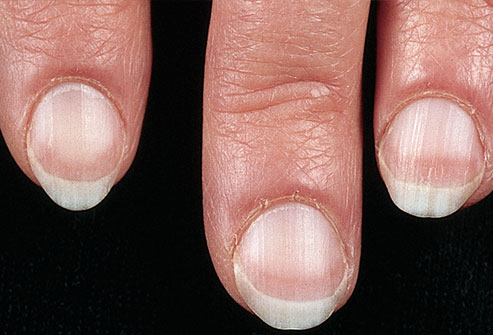
White Nails


If the nails are mostly white with darker rims, this can indicate liver problems, such as hepatitis. In this image, you can see the fingers are also jaundiced, another sign of liver trouble. 
 
Yellow Nails
 
One of the most common causes of yellow nails is a fungal infection. As the infection worsens, the nail bed may retract, and nails may thicken and crumble. In rare cases, yellow nails can indicate a more serious condition such as severe thyroid disease or psoriasis 
 
Bluish Nails

Nails with a bluish tint can mean the body isn't getting enough oxygen. This could indicate an infection in the lungs, such as pneumonia. 
 
Rippled Nails

If the nail surface is rippled or pitted, this may be an early sign of psoriasis or inflammatory arthritis. Psoriasis is a skin condition that starts in the nails 10% of the time. 
 
Cracked or Split Nails

Dry, brittle nails that frequently crack or split have been linked to thyroid disease. Cracking or splitting combined with a yellowish hue is more likely due to a fungal infection 
 
Puffy Nail Fold
 
If the skin around the nail appears red and puffy, this is known as inflammation of the nail fold. It may be the result of lupus or another connective tissue disorder.
 
Dark Lines Beneath the Nail
 
Dark lines beneath the nail should be investigated as soon as possible. They are sometimes caused by melanoma, the most dangerous type of skin cancer. 
 
Gnawed Nails
 
Biting your nails may be nothing more than an old habit, but in some cases it's a sign of persistent anxiety that could benefit from treatment. Nail biting or picking has also been linked to obsessive-compulsive disorder. If you can't stop, it's worth discussing with your doctor.
 
Nails Are Only Part of the Puzzle
 
Though nail changes accompany many conditions, these changes are rarely the first sign. And many nail abnormalities are harmless -- not everyone with white nails has hepatitis. If you're concerned about the appearance of your nails, see a dermatologist 


Article from: WebMD

May 18, 2010

Eat & Drink: Taste migration


The pasar malam has been a part of the Malaysian lifestyle for as long as I can remember.

I remember sporadic evening visits to the night market as a child, delighting in the putu mayam stall, waiting (eagerly) for the rice flour and coconut concoctions to finish steaming as the sweet smell of jaggery wafted past my impatient nose.

I remember the yards and yards (or maybe it just seemed that way to a small child) of clear plastic jars filled with assorted biscuits, crumbly sugee cookies, stripey pepper biscuits, and cashew nut-topped confections; the smoky satay grill with the ever patient satay man fanning the fire; and the Nyonya kuih stall fronted by rows of colourful kuih cut straight from the end of a rainbow.

But that was then. Recent visits to the pasar malam show that jostling for space with the putu mayam stall is a man frying up tteokbokki, Korean rice cakes in a shiny sauce made with gochujang (chilli paste); a stall selling mini cakes known as "China burgers"; a Taiwan pizza stall and various others selling snacks smacking of Japanese street food.

Even local food such as the carrot cake has undergone a metamorphosis of sorts, being cubed, battered and deep fried and then topped with a secret sauce!

These are signs of the changing times, of global economy and a shrinking world.

While I revel in all these new taste experiences to be found at the pasar malam, in my heart there will always be a place for the putu mayam man.

Check out these tasty new offerings at a pasar malam near you.

China burgers
These are fluffy pancake-like snacks with a filling in the middle. Fluffy batter encases a layer of minced chicken, egg and whichever filling you choose: minced pork, sardine, kimchi, baby octopus, hot dog, tiger prawn, ham, Korean laver (seaweed) or spring onion.

It's all cooked in what looks like a large muffin pan with the batter going in first, then the minced chicken and egg when the batter is set. The result is a tasty mouthful of layered flavours. Depending on the filling you choose, one China burger will set you back between RM1.50 and RM2.

Check it out at: Serdang and SS2, Petaling Jaya (Monday); Sungai Long and Taman Seri Petaling (Tuesday); Taman Connaught and Seri Rampai, OUG (Wednesday); Taman Segar and Taman Muda, Cheras (Friday) and SS13, Subang Jaya (Sunday).

China burgers
 
Deep-fried mushrooms and homemade tofu

Even in the hordes that make up a pasar malam crowd, it's a cinch to find this stall – just follow the shrill piped cries of "tofu" that emanate from a speaker above the head of the man at the wok.

He's dishing up freshly-fried battered oyster mushrooms and homemade tofu. The mushrooms – hot, crisp and slightly oily – are RM3 for 10 or RM5 for 17. The tofu, made from a combination of tofu and fish paste, is RM3 for seven pieces and RM5 for 12. There's chilli sauce to go with it but it's just as good without.

And soaking quietly at the side of the same stall – fishballs in curry or tom yum sauce.

Check these out at: SS2 (Monday); Sungai Long (Tuesday); Taman Connaught (Wednesday); Overseas Union Garden (Thursday); Kepong (Saturday); and Selayang Jaya (Sunday).

Deep-fried mushrooms and homemade tofu
 
Roda crispy short cake

Look for a stall named Hojia and you will find some intriguing-looking flat sheets with toppings laid out as if on pedestals.

These semi-crisp sheets are made with rice flour then topped with dried cuttlefish, ground peanuts and a spicy sauce; or chicken floss, sesame seeds, fried shallots and Thousand Island sauce. They are RM2.50 apiece.

The location for this stall isn't fixed and it tends to move around. However, there's a good chance you'll find it at the SS2 pasar malam on Mondays.

Roda crispy short cake
 
Baby octopus skewers

Alongside the sausages offered at the Double Dragon Taiwan Sausage stall are skewers of baby octopuses. These are the seasoned cephalods you typically find in Japanese restaurants, preserved with vinegar and marinated in a sweet-tangy sauce, served with additional sauces such as wasabi mayonnaise, salad sauce or Thousand Island.

Check it out at: SS2 (Monday); Seri Petaling (Tuesday); Taman Connaught (Wednesday); Kok Doh (Friday) and Kepong (Sunday).


Battered carrot cake and fried rice cake 

Madam Teh's Nyonya Nasi Lemak stall also sells carrot cake that has been flavoured with dried shrimps, then cubed, battered and deep fried to a crunchy finish. Mayonnaise and chilli sauce are then squeezed over it for a flavour twist.

A similar rice cake version is topped with either shredded yam bean, carrot and salad, or radish and chilli.
Both offerings are RM2 per serving.

Check them out at: Taman Len Sen, Cheras (Monday); Kuchai Entrepreneurs Park (Wednesday); Overseas Union Garden (Thursday); Taman Seraya, Cheras (Friday); Batu 14, Puchong (Saturday) and SS13, Subang Jaya (Sunday).


Taiwan Pizza

It's amazing how moreish a simple dough of flour and water can become when it's mixed with chopped spring onions and sesame seeds, and fried in fragrant peanut oil. That's the basis for the crisp, flavourful Taiwan pizza, which the stall-owner first rolls flat like a pizza base and then fries until crispy. It's even cut into segments (70 sen per piece) just like a pizza.

Check it out at: SS2 (Monday); Seri Petaling (Tuesday); Taman Connaught (Wednesday); Chao Yang, SS2 (Thursday); and Taman Midah, Cheras (Friday).


Flavoured tau foo fa

Tau foo fa is one of the most established street food desserts in Malaysia but if you like a twist to this old favourite, look for the flavoured tau foo fa stall. Choose from chocolate, corn, pandan, mango and yam flavours served in syrup to enjoy this silky smooth soy bean pudding at RM2.50 per bowl. You have the option of adding nata de coco, chocolate rice or longan for an extra 50 sen.

Check it out at: SS2 (Monday); Seri Petaling (Tuesday); Taman Connaught (Wednesday); Overseas Union Garden (Thursday); and Taman Seraya, Cheras (Friday).

May 17, 2010

Development of a child's digestive system

By Prof Dr Christopher Boey Chiong Meng

ONE of the most joyful experiences in life is when we welcome a baby into this world. Most mothers delight in the experience of nurturing, cuddling, and breastfeeding their little ones. At birth, your baby is dependent on you for almost every single aspect of his life and survival – he cannot walk as his central nervous system has not fully matured nor can he talk as his brain is still developing.

However, your baby is able to fully enjoy the nutritional benefits breast milk provides as his digestive system is mature enough to digest it at the time of his birth.

Gut development

When a foetus is formed in his mother’s womb, three layers of cells gradually develop to become the three main components of his body. The first layer forms the nervous system and sensory organs while the second layer forms his muscular, circulatory, and skeletal systems. The third layer of cells forms the digestive system. Your baby’s intestines start to develop as early as week five of pregnancy.

During the third month of foetal development, the foetus’ stomach cells start to secrete fluid. Waste that forms from the foetus goes through the placenta and into mother’s blood. This means that the digestive system has already started functioning even during the foetal stage.

At birth, your baby’s digestive system is still developing and maturing. At this point, he is not ready to accept other types of food except breast milk.

At about six months, your baby’s digestive system is mature enough to digest more complex and solid food substances, like starch, protein, and fat in a non-milk diet. At this stage, he’s ready to be introduced to solid foods (complementary food). It is recommended that you continue giving your child breast milk as he gradually gets used to eating solid food.

In his early childhood, your child’s digestive system continues to mature. The first two years are the most critical. The gut microflora established during this period can greatly influence your child’s long-term immunity. If your child’s digestive health is poor and he is malnourished at this point, his growth and development will be jeopardised.

Within your baby’s gut

At birth, your baby’s gut is sterile. As soon as you start breastfeeding, bacteria are introduced into your baby’s gut. Mother’s breast milk has several beneficial bacteria, e.g. bifidobacteria and lactobacillus, which are crucial for your baby’s gut health. The number of bacteria, both the good and bad bacteria, increases rapidly in the baby’s first few days of life.

As your baby grows, his gut microflora established during his first two years stabilises, and it usually maintains a balance until he reaches adulthood.

A healthy gut microflora ecosystem is essential to your baby’s overall health. Babies that don’t have the right balance of gut bacteria are likely to be more prone to colic (gas and pain in the abdomen), and are believed to be at greater risk of developing allergy (e.g. eczema) and asthma when they grow up.

Breastfed vs. bottle-fed

Breastfeeding can help your child achieve optimal growth, development, and health. Studies have suggested that children who are breastfed have significantly fewer gastrointestinal, ear, urinary, and respiratory infections. Breast milk is rich in antibodies and it can better protect your child against infections. Breast milk will also encourage the colonisation of good bacteria in the newborn’s gastrointestinal tract.

Formula fed babies’ gut microflora have been found to be different from breastfed babies. Formula-fed infants tend to have far less bifidobacteria, a bacteria that contributes towards the development of healthy gut microflora. Some studies suggest that there is increased risk of atopic eczema in infants who are given formula milk compared to those who are exclusively breastfed.

Moreover, bifidogenic factors that are found in breast milk help to boost the growth of beneficial bacteria in the gut, which lessens the risk of diarrhoea and other intestinal illnesses. In other words, breast milk keeps the digestive system in good condition.

It is therefore essential to breastfeed babies, especially during the first few days of life. The World Health Organization (WHO) recommends that mothers breastfeed their children exclusively for at least the first six months and continue breastfeeding their child up till the age of two years. In fact, both UNICEF and WHO encourage mother’s to breastfeed up to two years, if possible. This is because children’s immune systems are not as strong yet, so they need more protection, which breast milk can provide.

Care for your child’s digestive health

You might think the digestive system is merely to help us digest food, but the truth is, it plays a much bigger role. Without a healthy digestive system, your child can’t get all the nutrients he needs to grow properly and stay healthy. A problematic gut can affect your child in several ways, including his body weight, nutritional status, immune system, and even his emotions.

Your child’s digestive system is his “food processing machine”. Food must first be adequately broken down and properly absorbed before it can be utilised by his body. If any part of the process goes wrong, your child’s nutritional status is at risk, and when this happens, it may affect his physical as well as cognitive development.

Your child’s digestion affects his metabolic rate, which in turn affects his overall weight. Good digestion helps optimise metabolism. When your child is not properly nourished, it interferes with nutrient breakdown, absorption, and metabolism, which leads to accumulation of toxins in the body.


This makes sense as your digestive tract makes up the largest surface area in your body and is exposed to an enormous amount of food during a lifetime.

So, if you want your child to grow and stay healthy for many years to come, start taking good care of his little tummy now.


Prof Dr Christopher Boey Chiong Meng is a professor of paediatrics and consultant paediatric gastroenterologist. This article is not in any way intended as a substitute for medical attention. When in doubt, please consult your doctor. This article is courtesy of the Malaysian Paediatric Association’s Positive Parenting Digestive Health Initiative and the Malaysian Society of Gastroenterology & Hepatology that is supported by an educational grant from Vitagen Healthy Tummies Programme. For further information, please visit www.mypositiveparenting.org. To know more about children’s digestive health, please contact 03-56211408 or 03-56323301 for a free digestive health booklet by the Malaysian Paediatric Association’s Positive Parenting in collaboration with the Malaysian Society of Gastroenterology & Hepatology.

May 08, 2010

I Am Blessed To Be A Mother

Mother's Day is just around the corner and I am feeling all soft and warm inside just thinking about my little boy and what it means to be a mother.

I remember that day so vividly. I was with my hubby at the hospital for my check-up. My baby was 2 weeks overdue and didn't seem to be in any rush to come into the world. The doctor had to give him a bit of a prompting. After an hour of labour, we welcome HS into our lives. My parents and my in-laws were so excited because he's their first grandchild (which means he's in for a lot of pampering).

From that day on, my life was just an incredible journey of discovery with my little boy. I am blessed to be able to share his 'firsts'... his first cry, his first smile, his first little wriggle, his first crawl, his first little step, his first hug, his first little teeth, his first word, his first day at nursery, his first drawing, his first song... and the list goes on.

I still remember the first flower he gave me. He was just 1 year old then. My hubby was playing with him at the field and my baby got the urge to pluck a daffodil amongst the grass. With the little flower in his tiny hand, he indicated for his daddy to carry him and find his mummy (that's me!). It's amazing how he did that... he still haven't started talking but his daddy always seem to understand him. His little face look so sweet with his tiny mouth smiling when he gave me the flower. Precious moment.

He is such a sweet and loving boy, so independent, resourceful and intelligent. He always know how to work his magic on the people around him, especially the elderly. He seem to know when people are sad or unhappy and will start making these cute little faces or say funny jokes in an effort to cheer them up.

I am so blessed and happy to have him in my life. I love you my little 'popo' (precious).

All mother's have their special stories about their children and we are all such better persons because of them.

I would like to dedicate the video below to my mother, my mother-in-law and all the lovely mothers in the world.

Happy Mother's Day! Selamat Hari Ibu!

Warm wishes,
Sany Woo


May 05, 2010

The lowdown on feeding newborns cow's milk


MANY Malaysian mothers do not breastfeed their newborn babies. The babies are given bottled milk at birth or within a few months after birth. The bottled milk is usually derived from cow's milk which comprises protein, fat, sugar, vitamins and minerals mixed with water. Some babies are allergic to the proteins in cow's milk. This occurs despite the efforts of the milk manufacturers to produce bottled milk that is as close to mother's breast milk as possible.

It is generally accepted that about 1% to 5% of infants are allergic to the proteins in cow's milk and its various formulations.

Nasty reaction: Up to 5% of infants are allergic to the proteins in cow's milk and its various formulations. To avoid the allergy it is advisable to breastfeed the baby for six months or more.

Most infants will, fortunately, outgrow the milk allergies by the time they are two or three years old.

Milk allergy has to be distinguished from lactose intolerance. The former involves the body's immune system but the latter does not. Milk allergic reactions occur with the smallest amount of milk consumed.

Lactose intolerance is usually dose related - small amounts are tolerated by the body but larger amounts lead to a reaction which may mimic milk allergy.

Lactose intolerance is of slower onset than milk allergy and is not life-threatening. It is a harmless condition.

Milk intolerance is due to lactose intolerance which is the inability of the gastrointestinal system to absorb lactose, the primary sugar in milk and milk products such as milk powder, butter, margarine, cheese, yoghurt and chocolate. The lactose composition of milk products can be found by reading the labels of the products.

Lactose comprises two sugars bound together. Its absorption can occur when it is split up into two smaller sugars by an enzyme called lactase which is produced by the cells lining the small intestine. If the amount of lactase is low or absent, the body cannot or would have difficulty in splitting the lactose into two smaller sugars. The lactose then passes into the large intestine where the bacteria there cause it to ferment, producing a large amount of gas.

The amount of lactase in the intestine is high in babies. As the baby grows, the amount of milk consumed decreases leading to a reduction in the amount of lactase in the intestine.

Many Asians are at risk of developing lactose intolerance unlike adults in Europe and North America. Many people develop lactose intolerance when they have diarrhoeal diseases, during which the lining of the small intestine is slightly damaged by the frequent bowel movements. This results in a reduced production of lactose by the cells lining the small intestine.

Other causes of lactose intolerance are diseases of the stomach or intestines and its surgical treatment.

There are, however, some people who have low lactase levels but who are not lactose intolerant. The reason for this is unknown. The symptoms of lactose intolerance are abdominal distension and/or colic, stomach rumbling, increased passage of wind, nausea and diarrhoea.

There is marked variation in the symptoms of lactose intolerance. Some people do not have problems but others have symptoms with a small amount of lactose. Some do not have problems with certain foods which contain lactose but cannot tolerate other lactose-containing foods.

Self diagnosis of lactose intolerance is not difficult. This is done by refraining from consumption of lactose containing foods for a few days and then drinking two to three glasses of milk. If there is a tummy ache or diarrhoea within 30 minutes or so, it is likely that there is lactose intolerance.

The diagnosis of lactose intolerance can be confirmed by tests done by the doctor. One test involves measuring the blood sugar before and after drinking a lactose containing fluid. If the blood sugar is increased, there is no lactose intolerance. Another test involves analysing the breath for hydrogen gas after drinking a lactose-containing fluid. Hydrogen gas will be present if there is lactose intolerance as the lactose-containing fluid will be fermented by the bacteria in the large intestine. If one has an endoscopic examination, which involves passing a tube-like instrument into the stomach and intestine, the lining of the small intestine may be analysed.

Treatment

The treatment of lactose intolerance depends on the severity of the symptoms. If the symptoms are mild, all that is necessary is to reduce the consumption of milk and milk products. If the symptoms are severe, a lactose-free diet would be necessary. The doctor will, in such situations, refer the patient to a dietician who will advise on the composition of a lactose-free diet.

Lactose intolerance can be prevented by abstaining or reducing the consumption of milk and milk products when one has diarrhoea or has just recovered from it.

There are two ways in which cow's milk allergy present: gradually or suddenly. It usually presents gradually before the baby is six months old. The clinical features commonly occur with the passage of loose stools, blood in the stools, vomiting, colic, irritability and poor growth.

It can also present suddenly and rapidly with vomiting, wheezing, swelling of the skin and eyes, and rarely, anaphylactic shock, which is a sudden and severe allergic reaction involving the whole body and which is life threatening. This usually occurs soon after contact with the cow's milk allergen. Both the cardiovascular and respiratory systems are affected with marked changes in the blood pressure and breathing difficulties. Most babies will outgrow their allergy to cow's milk by the time they are two to four years of age.

Cow's milk allergy may also be associated with other allergies like eczema and asthma. If the cow's milk allergy is not addressed adequately, it may lead to effects on growth with failure to thrive and nutritional deficiencies. The management of cow's milk allergy is premised on avoiding cow's milk. This would include a breastfeeding mother avoiding dairy products in her diet, lest it be transmitted to the baby in the breast milk.

The formula for bottle-fed babies has to be changed to one that is soy or hydrolysate-based. The latter contain cow's milk proteins which are less allergenic because they have been broken down. If the allergy is severe, an amino acid based formula is used. Most manufacturers market “hypoallergenic” formula products.

It is important to remember that there is cross allergy between cow's milk and soy milk in up to 50% of the late onset type of cow's milk allergy and 15% of the rapid onset type. If the allergy is severe, treatment with medicines like anti-histamines and adrenaline will be necessary. Vitamin supplementation may also be necessary.

If there is a family history of allergies (eczema and asthma), it is advisable to totally breastfeed the baby for six months or more. This will delay the onset of symptoms if the baby has cow's milk allergy. There are other benefits of breastfeeding which include improved immunity for the child and bonding.

If one wants to provide cow's milk in a child's diet, this may be done when the child is 12 to 18 months old. However, it is advisable to do this under medical supervision. It is important to check all food labels and avoid any food that contains milk or milk products. Advice from a doctor or dietician would be useful if one is unsure.


Dr Milton Lum is a member of the board of Medical Defence Malaysia. This article is not intended to replace, dictate or define evaluation by a qualified doctor. The views expressed do not represent that of any organisation the writer is associated with.

December 12, 2009

Banana Nutrition

BANANA - This is my all time top superfood as it has some extremely powerful effects on the body and, as well as being high in minerals, will amaze you in more ways than one:

The fibre from unripe bananas reduce bad cholesterol and increase good cholesterol by up to 30%. The fibre in bananas is also helpful for constipation.

A ripe banana will soothe an upset stomach.

Bananas are a great energy source for the body which is instant and sustained.

Bananas can relieve heartburn.

They can also help decrease the risk of stroke by as much as 40%.

People suffering from depression feel better after eating a banana as the tryptophan in the banana is converted by the body into serotonin, which helps you relax, improves mood and makes you feel happier. Also helpful for people suffering from Seasonal Affective Disorder (SAD).

Bananas help to regulate blood glucose levels as they also contain the vitamin B6 and can also help with PMS.

Bananas contain iron and can help with anemia.

They are also great for high blood pressure as they are high in potassium and low in salt. The potassium can also help you feel more alert so good for children's packed lunches.

Bananas are great for hangovers - make a milkshake and add honey - the banana calms the stomach and the milk soothes and re-hydrates your body.

If suffering from morning sickness, a banana can help as it keeps blood sugar levels up.

The inside of a banana skin can reduce swelling and irritation from insect bites.

The B vitamins in bananas can help calm nerves.

Bananas are a great mid-morning snack, if watching your weight, as they keep sugar levels steady (great for diabetics), so you are less likely to crave a high carb snack.

If you suffer from Ulcers, bananas are great as they are gentle on the stomach, they neutralize over-acidity and reduce irritation by coating the lining of the stomach.

Bananas can lower both the physical and emotional temperature of expectant mothers.

If you are trying to give up smoking, bananas can help as the B6, B12, potassium and magnesium found in bananas help the body to recover from nicotine withdrawal.

Bananas contain potassium, which is a vital mineral for the body and affects heartbeat, oxygen to the brain and also regulates water balance. Stress depletes potassium, so bananas can be very valuable in rebalancing potassium levels.

You can get rid of a wart by taping the inside of the banana skin over it.

You can even shine your shoes with the inside of a banana skin, then polish with a dry cloth!

When you compare it to an apple, it has 4 times the protein, twice the carbohydrate, 3 times the phosphorus, 5 times the vitamin A and iron, and twice the other vitamins and minerals.

So, I think you'll agree with me that we should all 'go bananas' and try and eat more of this amazing health-giving fruit!


Author: Wendy A Wood
Article Source: EzineArticles.com

December 10, 2009

Parenting Children - Common Mistakes and How to Avoid Them

Parenting children is not easy! We all love our kids and want the best for them, right? But what if our habits and everyday behaviours are having a negative impact on our child's development? If you knew what you were doing wrong would you do something to change it? Would you want to be a better parent?

At school they stand out like beacons. They always arrive late to school looking like they just rolled out of bed. They don't have their homework completed on time and that important excursion note that was due back today remains unsigned in their school bag. They forgot to pack their lunch and aren't quite sure who is picking them up after school. Their belongings are un-named and not a day goes by without losing something. Their teachers label them as unreliable and their classmates would prefer to play with somebody else who isn't constantly in trouble.

What we might not see is the child's parent who makes a habit of turning up late to everything even when there is no real reason to do so. The parent who leaves everything to the last minute like ordering the school books for the new school year only to find that the book shop has run out of supplies and will need to back-order. The parent who never has time to read the school newsletter and doesn't realise that tomorrow is plain clothes day or that Monday is a pupil-free day. Parenting children to this parent is something you only need to think about after something goes wrong.

These are common traits of disorganisation found in most of us at some time or another. But when they become ingrained into our everyday functioning and spill over into our parenting then the impact on our children can be profound. The child of a chronically disorganised parent is often de-sensitized to preparing ahead for any event and will suffer the consequences both now and later in life. They will most likely find regimented school life difficult and will never enjoy the carefree feeling that today is going to be a good day. Instead, each day will be filled with the expectation that bad news is to come. With child depression at spiralling levels, parenting children the right way has never been more important.

The good news is that it is never too late to change. Put yourself in your child's shoes for a moment and think about how much easier his life would be if he had the skills to pre-plan and be organised. Now adopt that skill set in your own life first and show him by example how it is done. Parenting children isn't such a mystery. Get organised, be a better parent and both you and your child will reap the lifelong benefits.


Article Source: EzineArticles.com
Provided by: Canada duty rates

December 05, 2009

Enjoy These Tips for Living a Healthy Life

What is more important than the way you feel? Is there anything more important? Your physical health, the way your body "feels", is probably the most important determining factor in the way you feel. Any feeling, weather it be physical or emotional is experienced through our bodies and by applying these simple tips for living a healthy life, the way you feel will vastly improve.

Psychoneuroimmunology, the science of the mind-body relationship, has now produced scientific evidence of the effect of your mind on your body and vice versa. Depressed people use their bodies in a certain way that causes them to feel depressed and by just changing simple things like their facial expressions, studies have shown, they can literally change the way they feel instantly.

The significance of this fact is that it proves beyond a shadow of a doubt that our physical bodies have a tremendous effect on the way we feel both physically and emotionally. The one thing we are all pursuing in life is happiness and happiness is nothing but "feeling good." By following some basic tips for living a healthy life we can make significant changes in the way we feel physically, emotionally and mentally.

We've all heard the cliche "a healthy body houses a healthy mind" and thanks to scientific research we now know this for a fact. Also, the opposite is equally true: a healthy mind equals a healthy body. If we learn to be in control of our emotional association to food, we will automatically take care of our bodies. The instant satisfaction we get from junk food caused a lot of people to make pleasurable association (in their subconscious minds) to these foods that lead to overeating and addiction.

Living a healthy life starts with your body. If you take care of your body you will develop that sense of pride in yourself and the consequently the way you feel about yourself (or your self esteem).

With this in mind, let me offer you some very simple and basic tips for living a healthy life.

Firstly, realize the importance of oxygen to your body and your health. Breathing is not just to get oxygen to our vital organs. Every cell in your body requires oxygen for it's survival and health.

You are only as healthy as the cells in your body. In order to fully oxygenate our bodies we must learn to breathe deeply, fully and effectively. Deep, diaphragmatic breaths will, apart from oxygenating your system, stimulate the movement of lymph fluid through the body. Lymph is the body's natural cleansing system, essential to keeping your cells free from toxins and maintaining a healthy environment for the cells of your body to live in.

To breathe properly you must breathe in the following ratio: inhale(1) : hold(2) : exhale(4). For example inhale for 4 seconds, hold for 8 seconds and exhale for 16 seconds. Doing this simple exercise with 10 deep breaths 5 times a day will vastly increase your health, your energy and help maintain a healthy immune system.

Secondly, understand the importance of water to your body and health. Our bodies consist mainly of fluids and water, along with oxygen is the basis of all life. Taking sufficient amounts of water is essential for health and life, but also we need to avoid foods that drain our bodies from vital fluids. Foods that are high in sugar, salt, caffeine and preservatives will actually absorb fluids from your body causing certain vital functions to shut down. Eating foods that are naturally rich in water is essential and include all fruits, vegetables and sprouts.

Your body is your temple and what you put in is what you get out. Stop abusing it and adhere to these simple tips for living a healthy life. The very least you must do to life a healthy life is to stop depriving your body from the two most essential element, water and oxygen.

Applying these simple tips for living a healthy life will vastly improve your health and consequently the way you feel. When we feel good life is a pleasure and we suck from it all the juice. Life is a gift and know that tomorrow is not promised to you. Live everyday like it's your last and constantly seek out tips for living a healthy life and improving yourself and the quality of your life. It's all out there and the only thing that is required to have whatever you want from life is for you to go and get it. Just do it and do it with passion and joy.

Article Source: EzineArticles.com
Provided by: Mobile device news

Related Posts